The Only AI Deposition Tool You Can Bill Directly to Your Client
Law firms hate SaaS overhead. Genovra is not overhead — it's a case expense.
Author
Johan Ang • June 10, 2026
QUICK VERDICT
Choose Traditional SaaS AI Overhead if:
- You prefer paying flat recurring monthly fees regardless of your case volume
- You do not bill software or litigation costs back to your client ledger
- You do not need matter-level invoices or financial receipts for AI usage
Choose Genovra AI if:
- You want a legal AI tool that can be expensed directly to the client matter
- You need a native Disbursement Invoice Generator to satisfy fee transparency
- You want to reduce your firm's technology overhead to near zero
Law firm partners have a long-standing aversion to software subscriptions. Every recurring software license added to the firm ledger represents fixed administrative overhead that compresses margins. However, litigation expenditures—such as court reporters, expert witness fees, and filing fees—are treated differently. These are case disbursements, billed directly to the client's matter ledger. Genovra AI is the only legal AI tool designed specifically to align with this accounting structure, utilizing a built-in Disbursement Invoice Generator to make AI costs 100% case-expensable.
Why Boutique Law Firms Hate Software Subscriptions
For a boutique litigation firm with 2–15 attorneys, managing cash flow requires careful control of overhead. Traditional legal AI tools charge high per-seat monthly subscriptions (e.g., CoCounsel at ~$225/user/month, Harvey AI at $50,000–$100,000/year). These fees must be paid every month, regardless of case volume or active discovery cycles.
Managing partners hate this model because it forces the firm to absorb the software cost as general business overhead. During months with low deposition activity, the software licenses sit idle while the firm continues to write the check. Furthermore, distributing these subscription costs across individual client ledgers is an administrative nightmare, forcing the firm's accounting staff to make arbitrary allocations that risk billing disputes.
What Is a Disbursement Invoice in Legal Practice?
In legal practice, a disbursement is a direct expense incurred by the firm on behalf of a client during representation. Common examples include overnight shipping fees, medical record copy charges, deposition transcript fees, and expert witness retainers. These costs are not part of the firm's overhead; they are advanced by the firm and reimbursed by the client from the settlement or recovery (or paid monthly in hourly billing arrangements).
By categorizing AI document processing as a direct client disbursement rather than firm overhead, managing partners can transition their technology spend from a margin-compressing cost center into a pass-through case expense. This is the model that Genovra AI facilitates.
How Genovra's Disbursement Invoice Generator Works
Every time an attorney or paralegal runs an analysis in the Genovra AI dashboard (such as parsing a medical record or transcribing an audio deposition), the system calculates the exact credit consumption for that specific run.
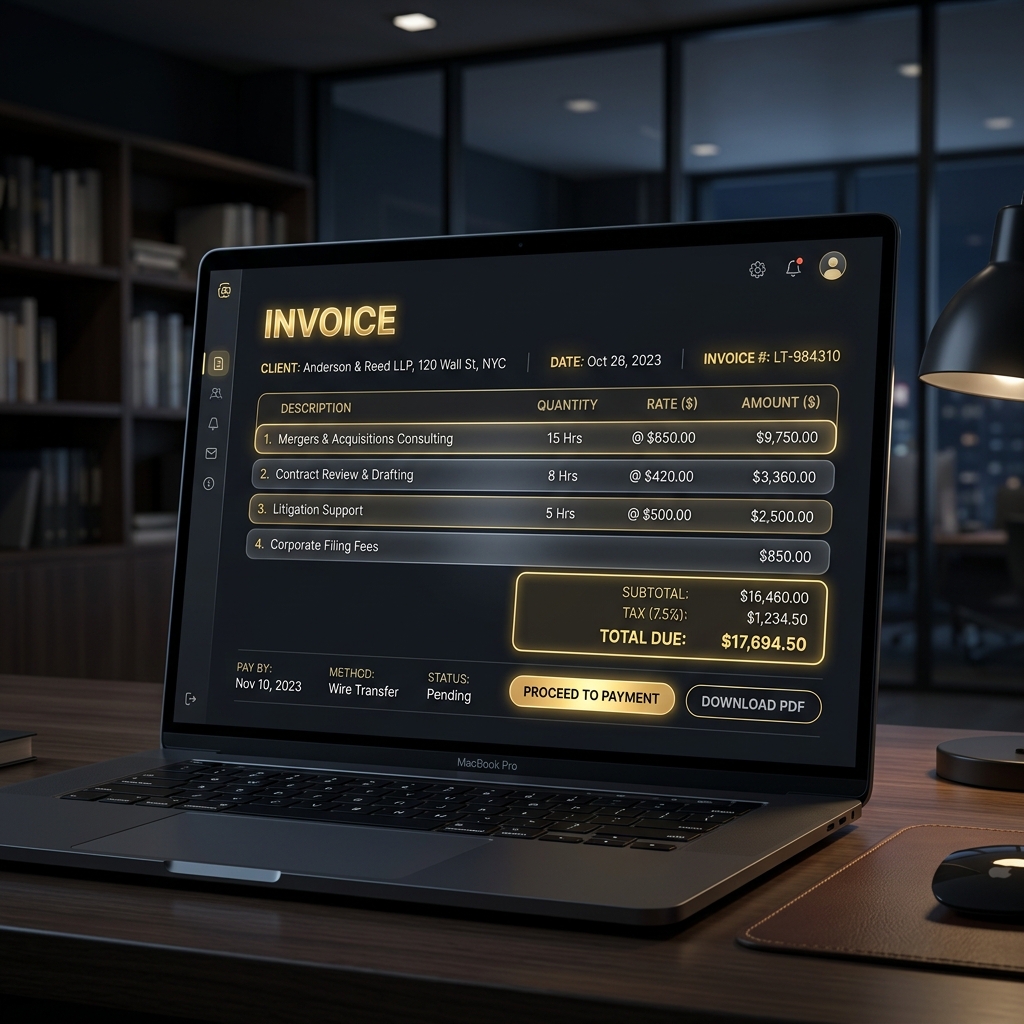
Once the analysis is complete, the dashboard automatically generates a client-ready, downloadable PDF Disbursement Invoice. This invoice includes:
- The date and time of the analysis run.
- The client matter name or case number (provided by the user).
- The exact credits consumed during the run.
- The equivalent dollar value of the credits, based on the firm's purchase rate.
- A breakdown of the processed file (e.g., "Deep Ear™ Audio Deposition Analysis, 4 Hours").
The firm's billing department can download this invoice and attach it directly to the client's monthly statement or discovery ledger, ensuring a clear paper trail for cost recovery.
What Does AI Analysis Actually Cost Per Case?
Under Genovra AI's Credit Pack pricing, the cost of processing is directly proportional to the document or media volume. At the Pro Pack rate ($497 for 3,500 credits), the cost per credit is $0.142. Here is what the actual disbursement cost looks like for typical case files:
- 400-Page Medical Record: Consumes 400 credits, representing a direct disbursement of $56.80.
- 4-Hour Deposition Audio: Consumes approximately 1,160 credits, representing a direct disbursement of $164.72.
- 100-Page Discovery PDF: Consumes 100 credits, representing a direct disbursement of $14.20.
Instead of paying thousands of dollars in human paralegal time to index these files manually, the firm processes them in minutes and bills the modest computational expense directly to the case ledger.
How to Bill AI Costs to the Client Ledger
To recover these costs ethically and transparently, firms typically add a line item to their client invoices under the "Disbursements" or "Expenses" section. The line item reads: "AI Paralegal Evidentiary Review (Case No. X) – [Date] – [Invoice Attached]... $164.72."
Because Genovra generates a detailed receipt for every single run, the firm has the documentation required to support the charge if a client or insurance carrier audits the bill. Contingency-fee plaintiff practices (personal injury, employment) simply add these receipts to the case file, deducting the advanced costs from the gross recovery upon settlement, ensuring a net cost to the firm of $0.
ABA Rule 1.5 and AI Fee Transparency
ABA Model Rule 1.5 dictates that all fees and expenses charged to a client must be reasonable. In August 2024, the ABA issued Formal Opinion 512, which specifically addressed the ethics of billing clients for generative AI tools. The opinion clarified that attorneys may charge clients for actual disbursements incurred when using third-party AI technology, provided the charge represents the direct cost of the service (or a reasonable markup that reflects the firm's actual administrative costs in provisioning the tool).
Genovra's per-analysis invoices satisfy this ethical transparency requirement by providing the exact credit-to-dollar math. The firm is not charging a vague, arbitrary technology fee; it is billing for the precise computational work performed on that client's specific files, backed by documentation.
Why No Other Legal AI Offers This
No major competitor in the legal AI space (including Harvey AI, CoCounsel, Dodonai, or CaseMark) offers a native disbursement invoice generator. Because these platforms are built on per-seat subscription models, their infrastructure is not designed to track and invoice individual file-level transactions.
If a firm using CoCounsel wants to bill a client for an analysis, the billing clerk must manually calculate how many minutes an associate spent using the tool, estimate the portion of the monthly license consumed, and draft a manual narrative. This is administratively impractical, leaving most firms to absorb the software as overhead. Genovra AI's transactional credit model is architected specifically to automate this cost recovery process.
ROI: The Math That Makes Genovra Free
When a firm leverages Genovra AI's Disbursement Invoice Generator, the return on investment calculation changes fundamentally. Instead of evaluating whether the software's time-savings justify its monthly cost, the firm evaluates the capacity recovered.
If a junior associate spends 12 hours manually indexing a 4-hour deposition, that time costs the firm capacity that could be spent on high-value brief writing. By processing the deposition through Genovra's Deep Ear™ in 12 minutes, the firm recovers those 12 hours. The software cost of $164.72 is billed directly to the client as a disbursement. The firm recovers the associate's capacity, speeds up case preparation, and incurs a net software cost of $0. The math makes the tool functionally free to the firm.
/ Technical Specification
BigLaw Scope vs. Boutique Depth
| Capability | Traditional SaaS AI Overhead | Genovra AI |
|---|---|---|
| Client-Ready Invoices | No | Yes |
| Matter-Level Billing Support | No | Yes |
| ABA Rule 1.5 Cost Recovery | Difficult (manual calculation) | Supported (itemized invoice) |
| Net Firm Overhead Impact | 100% of license fee | Net $0 (after client reimbursement) |
| Starting Price | Custom enterprise / Seat-based | $197 (Starter Pack) |
/ Frequently Asked Questions
Infrastructure & Compliance Details
How do you bill Genovra AI costs to a client?
For every run, Genovra AI generates a downloadable disbursement invoice. This can be attached to the client matter and billed as an AI paralegal expense or technology disbursement.
Is client-billing of AI tools ethically permitted?
Yes. ABA Formal Opinion 512 confirms that actual technological costs incurred can be passed through to clients, provided the billing is transparent and represents direct work on the matter.
Does Genovra require seat-based licenses?
No. Genovra uses flat-rate credit packs with unlimited users and firm-wide access, allowing your whole team to collaborate.
Stop the Paralegal Bottleneck.
We process 500 pages in 12-18 minutes with exact Page and Line citations. We run Genovra on a real document from a closed case before you pay.
Start Free Trial — 50 Credits, No Credit Card