The End of Hallucinations: Why Lawyers Need Deterministic AI
Predictive AI hallucinates. Deterministic AI proves it.
Author
Johan Ang • June 30, 2026
QUICK VERDICT
Choose ChatGPT (GPT-4o) if:
- You are drafting emails or generating ideas.
Choose Genovra AI if:
- You need factual certainty with exact Page/Line citations from your evidence files.
In 2023, the legal profession was shocked when attorneys were sanctioned for submitting ChatGPT-hallucinated case citations in a federal brief. This incident exposed a fundamental flaw in using general-purpose predictive AI for legal work. For boutique litigation firms, the solution is not to abandon AI, but to transition to Deterministic Legal AI—systems engineered specifically for Zero-Hallucination Sourcing with exact Page and Line citations.
The Hallucination Problem in Predictive AI
General-purpose chatbots like ChatGPT and standard Claude interfaces are built on Large Language Models (LLMs) that function as predictive text engines. When asked a question, they predict the most statistically probable next word based on their vast training data. They do not "know" facts; they generate plausible-sounding text.
In a creative writing task, this is a feature. In litigation, it is a liability. If a predictive AI cannot find an answer in the text you provided, it may confidently invent one to satisfy the prompt. This is known as a hallucination. As documented in our analysis of ChatGPT Lawyer Sanctions, relying on predictive AI for factual assertions without verification can lead to severe professional consequences and violations of ABA Model Rule 1.1.
What is Deterministic Legal AI?
Deterministic Legal AI represents a different architectural approach. Instead of predicting text based on generalized training data, a deterministic system is structurally constrained. It is programmed to act as a strict information retrieval and synthesis engine that only operates within the bounds of the specific documents you upload.
Genovra AI is built on this deterministic foundation. When you upload a 500-page medical record or a deposition transcript, the system's knowledge universe shrinks to exactly those pages. If you ask a question and the answer is not in the uploaded file, a deterministic AI will state that the information is missing, rather than inventing a plausible narrative.
Zero-Hallucination Sourcing (Exact Page and Line)
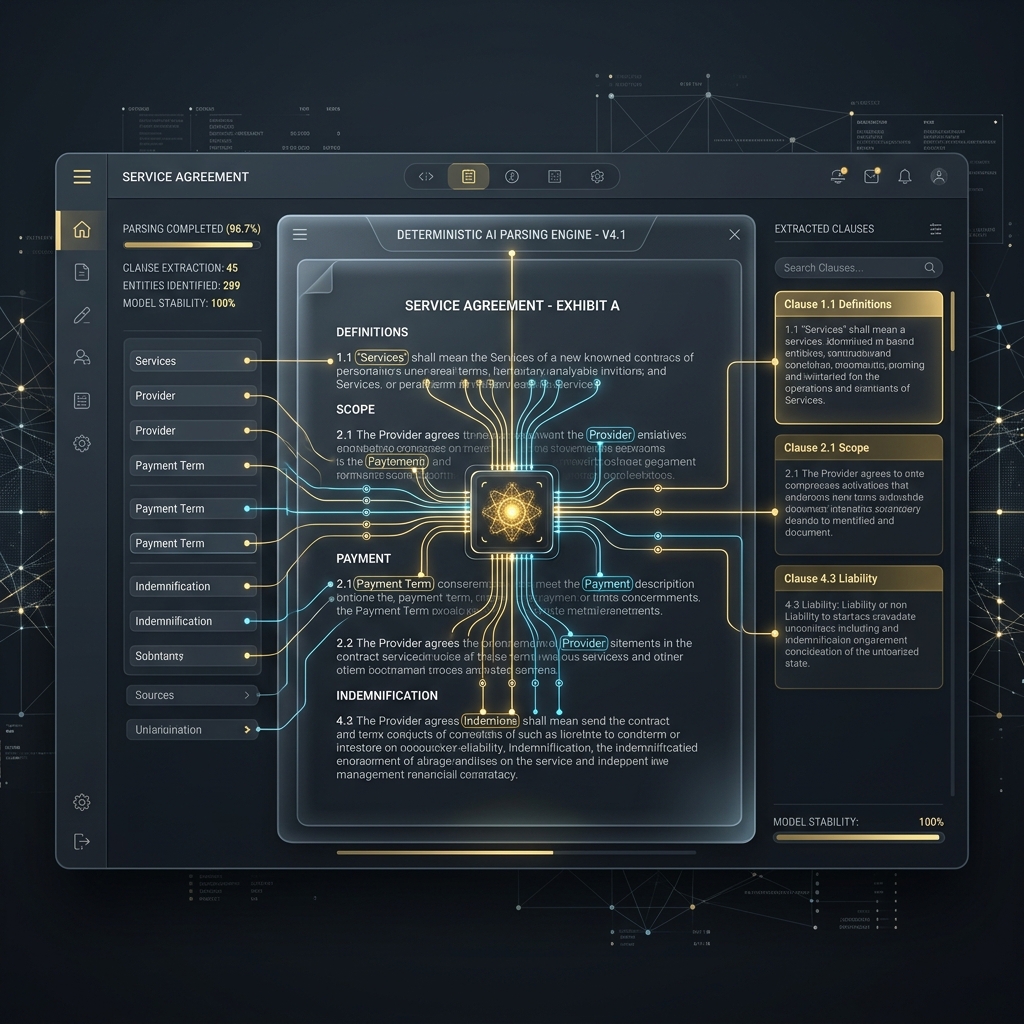
The core mechanism that enforces deterministic behavior in Genovra AI is Zero-Hallucination Sourcing. Every single factual claim generated by the system—whether in a Case Master Brief™ or during Precision Document Chat—must be anchored to an Exact Page and Line citation.
When the AI states, "The plaintiff complained of chronic lumbar pain on March 14," it must append the citation: (Exhibit B, Page 45, Line 12). In the Genovra dashboard, this citation is an interactive link. Clicking it opens the native PDF side-by-side with the summary, highlighting the exact sentence where the fact was found.
This provides two critical safeguards for litigators:
- Verification in Seconds: Attorneys can fulfill their ethical duty to supervise AI output instantly, without manually searching through hundreds of pages.
- Court-Ready Confidence: The generated citations are ready to be copied directly into motions for summary judgment, ensuring absolute forensic precision.
The Multi-Model Jury System
To further eliminate the risk of hallucination, Genovra AI employs a "Multi-Model Jury" architecture. Instead of relying on a single AI model to extract facts, Genovra routes the analysis through three or more parallel AI models (including GPT-4o and Claude 3.5 Sonnet) simultaneously.
These models independently review the document and extract facts. A consensus engine then compares their outputs. If the models disagree on a fact, or if a model cannot definitively link a claim to a Page/Line citation, the claim is rejected and excluded from the final brief. This rigorous internal cross-examination ensures that only verified, consensus-backed facts make it to your desk.
The Verdict: Safe AI for Litigation
Boutique law firms handling high-stakes litigation cannot afford the risk of hallucinated evidence. While general-purpose chatbots are cheap, the professional liability they carry is immense.
By upgrading to a Deterministic Legal AI platform with Zero-Hallucination Sourcing, firms gain the speed of automation without sacrificing accuracy. With Genovra AI, you can process complex medical records and discovery files confidently, knowing that every extracted fact is mathematically tethered to your source document.
/ Technical Specification
BigLaw Scope vs. Boutique Depth
| Capability | ChatGPT (GPT-4o) | Genovra AI |
|---|---|---|
| Hallucination Risk | High (Predictive) | Near-Zero (Deterministic) |
| Source Citations | None | Exact Page and Line |
/ Frequently Asked Questions
Infrastructure & Compliance Details
What is deterministic AI?
An AI engine structurally constrained to retrieve and synthesize facts only from the uploaded documents, preventing it from inventing answers.
Stop the Paralegal Bottleneck.
We process 500 pages in 12-18 minutes with exact Page and Line citations. We run Genovra on a real document from a closed case before you pay.
Start Free Trial — 50 Credits, No Credit Card