Deep Ear™: How Genovra AI Turns a 4-Hour Deposition Into a 12-Minute Intelligence Report
Reviewing a 4-hour deposition video takes 4 hours. Deep Ear™ does it in 12 minutes and auto-seeks to the exact second an admission was spoken.
Author
Johan Ang • June 10, 2026
QUICK VERDICT
Choose Manual Audio Summarization / Transcription if:
- You only work with certified written transcripts and never receive raw media files
- Your local court rules prohibit using uncertified transcription for case review
- You handle fewer than 1 deposition per month and have ample administrative capacity
Choose Genovra AI if:
- You want to review raw deposition audio or Zoom recordings in minutes
- You need speaker-attributed transcripts with clickable timestamp links
- You want to automatically detect evasion patterns and witness contradictions
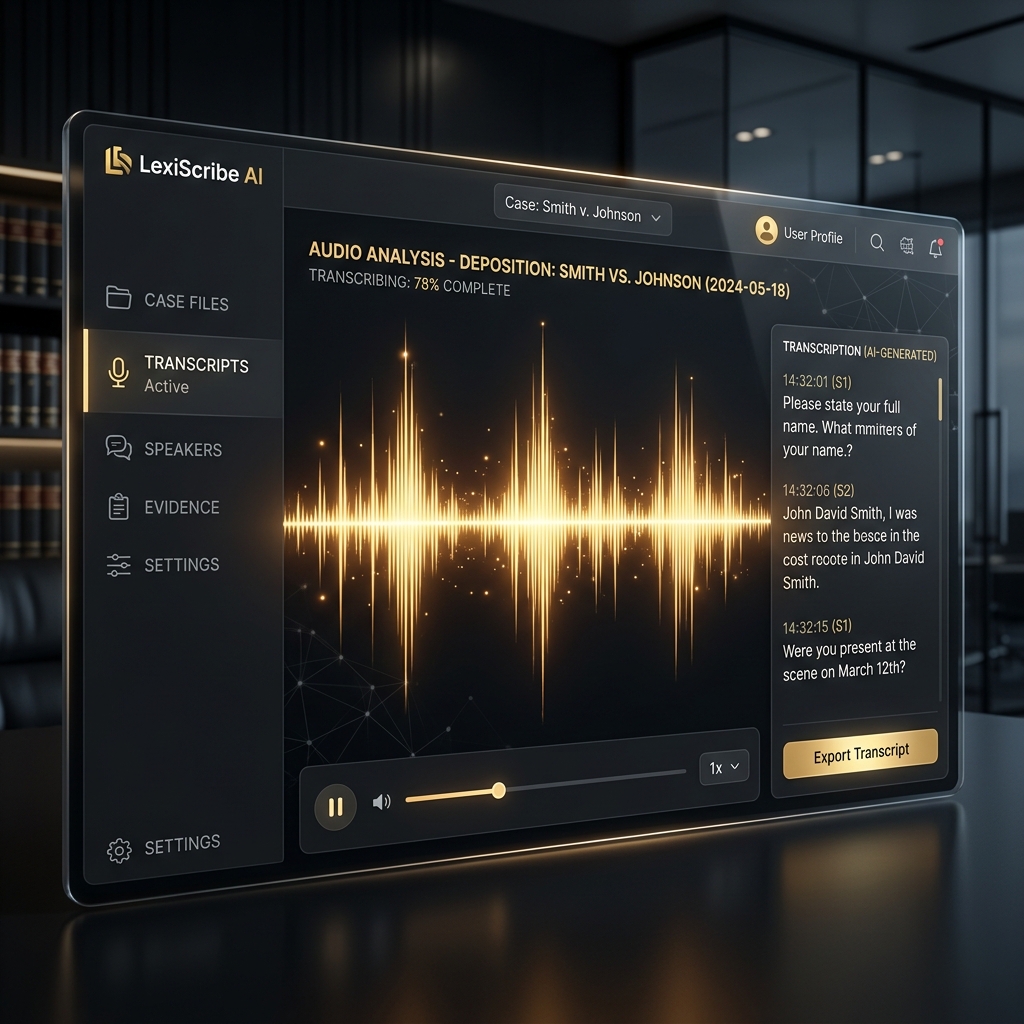
Reviewing oral deposition testimony is one of the most time-consuming tasks in civil litigation discovery. An attorney reviewing a raw 4-hour deposition recording must spend a full 4 hours listening to the media, stopping to type notes and index key admissions. Genovra AI's Deep Ear™ audio intelligence engine processes a 4-hour deposition in under 12 minutes, delivering a speaker-attributed transcript with clickable timestamp links, contradiction flags, and impeachment outlines.
The Deposition Review Problem
Depositions are the crucible of litigation discovery. Verbal testimony reveals the admissions, evasions, and contradictions that dictate settlement values and trial outcomes. However, extracting this intelligence from raw video or audio files is slow and expensive.
If an agency transcript is not yet certified, or if the firm wants next-day cross-examination outlines during multi-day depositions, the trial team must review the media manually. A partner billing at $500/hour who spends 4 hours reviewing a deposition video burns $2,000 in professional capacity. If they delegate the task to a junior associate or paralegal, the turnaround time is delayed, and manual transcript summaries often miss critical, fast-spoken admissions.
What Is Deep Ear™?
Deep Ear™ is Genovra AI's native audio and video processing engine. Unlike general transcription tools that simply output a wall of text, Deep Ear™ is engineered specifically for legal proceedings. It integrates automatic speech recognition (ASR) with legal fact-mapping pipelines to transcribe, index, and analyze depositions.
Deep Ear™ does not operate in isolation. It functions as the audio intelligence layer of Genovra's Case Master Brief™, automatically linking spoken statements to exact page-and-line entries in written case documents. This allows litigators to analyze verbal testimony beside written clinical charts and insurance records in a single system.
How Deep Ear™ Processes Audio
When an audio or video file is uploaded, Deep Ear™ initiates a multi-stage computational analysis. It runs diarization algorithms to isolate individual voice channels, separates overlapping speech, and maps audio waveforms to text. The transcription pipeline runs at a 20x speed ratio relative to real-time playback, processing a 4-hour deposition file in under 12 minutes.
Because the processing occurs in a secure memory environment, the raw files are never stored or logged on external servers. Genovra's Zero Data Retention (ZDR) policy guarantees that all media files are permanently purged immediately after the transcript is generated, ensuring complete confidentiality under Model Rule 1.6.
Speaker Attribution and Timestamp Auto-Seek
Traditional transcription outputs often struggle with speaker confusion, especially during fast-paced cross-examinations. Deep Ear™ utilizes acoustic clustering to separate speakers, identifying the deposing attorney, the witness, opposing counsel, and the court reporter, attributing every statement to the correct speaker.
The output transcript is interactive. Every line of text features an integrated timestamp link. Clicking a line in the dashboard opens the media player and auto-seeks to the exact second in the recording. If opposing counsel disputes a witness admission, the trial team can play the exact audio recording in court in seconds, removing any doubt about what was spoken.
Evasion Detection: What Deep Ear™ Flags Automatically
Witnesses frequently avoid direct answers, using verbal patterns designed to deflect liability. Deep Ear™ is trained to detect these evasion markers, automatically flagging instances where the witness is:
- Non-responsive: Deflecting the question or answering with unrelated facts.
- Redirecting: Attempting to shift liability to a third party or a pre-existing condition.
- Changing Story: Exposing internal inconsistencies within the deposition timeline.
These flags appear as visual markers in the transcript, allowing lawyers to identify evasive witnesses and focus their preparation on areas where the witness is defensive.
Contradiction Detection: Cross-Referencing Against Case Documents
The most powerful capability of Deep Ear™ is cross-document contradiction detection. It does not simply transcribe the deposition; it compares spoken statements against prior discovery files.
If a treating physician testifies that a plaintiff was fully compliant with physical therapy, but the physical therapist's clinical note on page 214 of the medical record indicates the patient missed 6 consecutive appointments, Genovra flags the contradiction. It provides a side-by-side view showing the spoken deposition statement and the written medical record note, cited by page and line. This gives the trial team immediate impeachment evidence.
The Cross-Examination Outline Output
Once the analysis is complete, Deep Ear™ generates a structured Mock Cross-Examination Outline. The outline lists 10–15 impeachment questions designed to challenge witness credibility during subsequent trials or hearings.
Each question is backed by the source contradiction, referencing the exact timestamp of the deposition recording and the page-and-line citation of the medical chart or discovery file. This outline can be exported directly to Microsoft Word (.docx) for use in court preparation.
Cost Comparison: Manual vs. Deep Ear™
The cost difference between manual review and Deep Ear™ is significant. Reviewing a 4-hour deposition manually costs approximately 4 associate hours ($1,000 capacity cost) or partner hours ($2,000). If expedited transcription is ordered from a court reporting agency, the hard cost increases by $900 to $1,500.
Under Genovra's Pro Pack pricing ($497 for 3,500 credits), a 4-hour deposition analysis consumes approximately 1,160 credits, representing a direct computational cost of $164.72. The analysis is completed in 12 minutes, and the $164.72 fee is billed directly to the client's case ledger using the built-in Disbursement Invoice Generator, resulting in a net technology overhead to the firm of $0. The firm recovers hours of associate capacity while keeping costs low.
Supported File Formats
Deep Ear™ accepts a wide range of audio and video formats, allowing firms to process media from multiple sources. Supported formats include:
- Audio: MP3, WAV, M4A, AAC, and WMA.
- Video: MP4, MOV, AVI, and Zoom cloud recording exports.
Firms can upload raw media files directly from their smartphones, digital dictation recorders, or videoconferencing platforms, with no file conversion required.
Data Security: Audio ZDR
Deposition recordings contain confidential testimony and sensitive case facts. Genovra AI enforces absolute confidentiality through a strict Zero Data Retention (ZDR) architecture. When you upload media files, they are processed in secure memory and permanently purged immediately after the analysis is generated. Genovra does not store your audio or video files, ensuring compliance with client confidentiality standards under Model Rule 1.6.
No competitor in the boutique litigation AI market offers native, credit-based audio processing with ZDR. While enterprise video platforms like DepoIQ exist, they require custom contracts and annual commitments exceeding $100,000/year. Genovra's Deep Ear™ brings enterprise-grade audio deposition intelligence to boutique practices on a flexible, credit-pack basis.
/ Technical Specification
BigLaw Scope vs. Boutique Depth
| Capability | Manual Audio Summarization / Transcription | Genovra AI |
|---|---|---|
| Native Audio/Video processing | No | Yes |
| Review Speed (4-hour depo) | 4 hours (real-time playback) | Under 12 minutes |
| Click-to-Verify Timestamps | No | Yes |
| Evasion & Contradiction Detection | Manual indexing | Automated flags |
| Cross-Examination Outline | No | Automated (Word export) |
| Starting Price | $900–$1,500 transcript cost | $197 (Starter Pack) |
/ Frequently Asked Questions
Infrastructure & Compliance Details
What is Deep Ear™?
Deep Ear™ is Genovra's native audio and video deposition intelligence engine. It transcribes media, attributes speakers, and flags witness contradictions.
What file formats are supported?
Deep Ear™ supports MP3, WAV, M4A audio files and MP4, MOV, AVI video files, including Zoom cloud recording exports.
How does it help during multi-day depositions?
It processes the first day's audio in 12 minutes, delivering timestamped contradiction outlines that can be used for next-day impeachment.
Stop the Paralegal Bottleneck.
We process 500 pages in 12-18 minutes with exact Page and Line citations. We run Genovra on a real document from a closed case before you pay.
Start Free Trial — 50 Credits, No Credit Card